
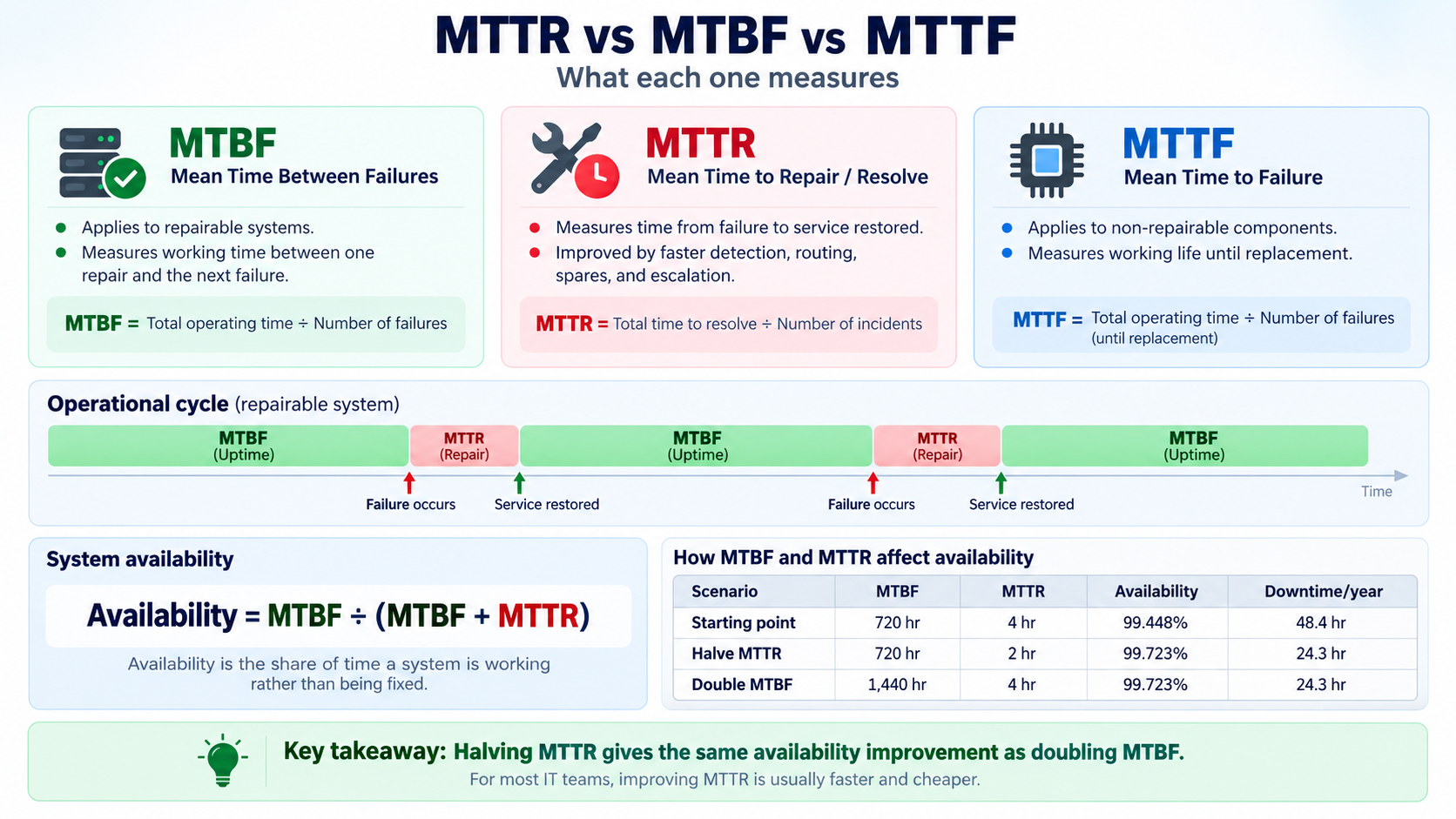
MTTR and MTBF get quoted together so often that people treat them as two versions of the same measurement. They are opposites. One counts how long things keep working; the other counts how long you take to fix them once they stop. Confusing them leads teams to spend money on the wrong half of the problem — usually the expensive half.
MTBF is mean time between failures — how long something runs before breaking. MTTR is mean time to repair or resolve — how long it takes to get running again. MTBF is a reliability measure you mostly buy; MTTR is a response measure you mostly manage. Together they give you availability: MTBF ÷ (MTBF + MTTR).
MTBF: How Long It Runs
If a switch runs for 8,640 hours over a year and fails 12 times, MTBF is 720 hours — roughly one failure a month. MTBF is a property of the thing itself: its design, its age, its operating environment, how well it was installed. You improve it by buying better hardware, adding redundancy, cooling the room properly, or replacing kit before it wears out. Those are mostly capital decisions.
Note the word between. MTBF applies to things you repair and put back into service. The clock covers the working period from one repair to the next failure.
MTTR: How Long You Take to Fix It
MTTR is a property of your team and your process, not of the equipment. It is improved by faster detection, better routing, having the right spare on the shelf, and not losing twenty minutes working out which device the ticket is even about. Those are mostly operational decisions, and they are usually much cheaper than capital ones.
MTTR also hides an ambiguity that MTBF does not: four different metrics share the abbreviation, and they measure different intervals of the same incident. The MTTR formula, worked through, and the four metrics that share the name covers that in detail.
The same cycle, measured from opposite ends
MTTF: The Third One People Confuse
MTTF — mean time to failure — applies to things you do not repair. A hard drive, a power supply, a fuse: when it fails you replace it rather than fixing it, so there is no "between" to measure. There is one working life and then it is over.
| Metric | Applies to | Measures | You improve it by |
|---|---|---|---|
| MTBF | Repairable items put back into service | Working time between one repair and the next failure | Better hardware, redundancy, environment, replacement cycles |
| MTTF | Non-repairable items that get replaced | Working time until it fails for good | Component choice and replacement before end of life |
| MTTR | Your team and process | Time from failure to service restored | Detection, routing, spares, context, escalation paths |
Availability: Where the Two Meet
Take a device with MTBF of 720 hours and MTTR of 4 hours:
| Scenario | MTBF | MTTR | Availability | Downtime / year |
|---|---|---|---|---|
| Starting point | 720 hr | 4 hr | 99.448% | 48.4 hr |
| Halve MTTR | 720 hr | 2 hr | 99.723% | 24.3 hr |
| Double MTBF | 1,440 hr | 4 hr | 99.723% | 24.3 hr |
So Which Should You Work On?
- If failures are frequent but short, work on MTBF. Repeated failures of the same device are a reliability problem, and no amount of fast response stops them recurring.
- If failures are rare but long, work on MTTR. A device that fails twice a year but takes six hours each time is telling you about your response, not your hardware.
- If you cannot afford new hardware, work on MTTR. It is the half of the equation you control operationally, and as the table above shows the availability maths does not care which half you improve.
- If the same incident keeps recurring, neither metric is your problem. That is problem management — find the cause rather than optimising the average.
How InfraCue Measures This
InfraCue reports both halves of the availability equation:
- MTTR. The tile reads MTTR · 30 Days and shows mean wall-clock time from ticket creation to resolution, on a rolling 30 days against the previous 30, with the ticket count behind the mean. Available workspace-wide on the admin dashboard and per-engineer on the infra dashboard.
- MTBF. The tile reads MTBF · 30 Days and shows mean wall-clock time between one ticket being raised and the next, measured over exactly the tickets MTTR uses — same eligibility, same rolling window, same comparison period — so the two cards describe one estate rather than two. Network Pulse feeds it indirectly rather than directly: a device that drops raises a ticket, and alerts are deduped to one open ticket per device, so an outage is already a single incident before it is counted. Workspace-wide on the admin dashboard, per-engineer on the infra dashboard.
- Device availability, measured rather than modelled. Network Pulse polls watched devices and reports availability as successful checks divided by total checks, per device, alongside a list of outages with their start time and how many consecutive checks failed.
InfraCue is free for 30 days — tickets, SLA timers, MTTR, MTBF and per-device availability from your own kit. No credit card, nothing to cancel.
Start a free 30-day trialCommon Questions
Is a higher MTBF always better?
Higher is better in isolation, but it is only half of availability. A device with excellent MTBF that takes two days to fix when it finally does fail can deliver worse availability than a less reliable device you can restore in an hour. Always read the pair together.
Can MTBF be measured for software or services?
It can, and increasingly is — time between production incidents for a service is a legitimate MTBF. The caveat is that software failures are rarely independent the way hardware wear-out is, so the average conceals more. A service that is stable for months and then fails five times in a week has an MTBF that describes neither period.
Where does MTTA fit in?
Mean time to acknowledge sits inside MTTR: it is the gap between the failure being detected and someone picking it up. It is worth tracking separately because it is usually the cheapest interval to shrink, and it is pure dead time.
Why do vendor MTBF numbers look impossibly high?
Because they are fleet statistics derived from accelerated testing, not a prediction about your individual unit. A 100,000-hour figure means roughly one failure per 100,000 accumulated running hours across many units. Use them to compare products, never to plan when yours will fail.
Do I need both metrics if I already track SLA compliance?
SLA compliance tells you whether you met a promise; MTBF and MTTR tell you why. A team breaching its targets because devices fail constantly needs a different fix from one breaching because each incident drags on. See what an SLA breach actually is for how those targets are set and missed.